3D-Printed Animatronic Finger
Role:
Lead Designer, Lead Modeler
Organization:
Personal Project
Dates of Involvement:
Fall 2024
Relevant Skills:
- Solidworks CAD
- Mechanical Design
- Arduino Programming
- Clay Modeling
- Silicone Casting

Internal Mechanism
The finger's core is a mechanism driven by strings at each joint. This design allows for independent movement at each joint, providing a high degree of freedom. Strings were chosen to keep the finger small, allowing powerful servos to be housed within the hand while the finger itself remained human-sized. This design was inspired by the efficient power delivery and compact form of real human fingers.
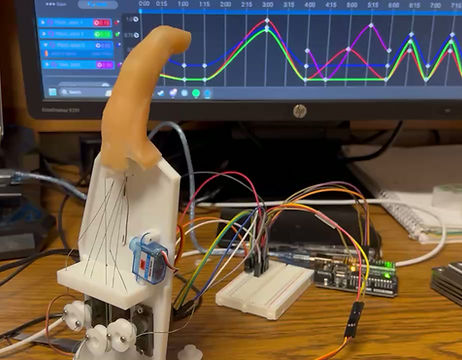
Silicone Skin
A silicone skin was developed to give the finger a realistic look and to gain experience with professional animatronics practices. First, a flexible mold was made from the mechanism. This mold was filled with plastic to create a solid copy, which served as a base for sculpting. Clay was used to sculpt a realistic finger around this core, and then a solid mold was made around the clay. Finally, silicone was cast into this mold to create the finished skin.


Overall Summary
This project involved designing and building a 3D-printed animatronic finger with realistic motion, multiple degrees of freedom, and a silicone skin. The finger was given four degrees of freedom, each controlled by a servo. These servos are managed by an Arduino, programmed with Bottango animatronic software. A lifelike skin was created using clay modeling, mold making, and silicone casting.

Electronics and Animation
An Arduino controls the finger, running an animation loop. To create this loop, I studied the natural range of motion of human fingers. Bottango software was then used to program realistic movements, showcasing the mechanism's capabilities while staying within the motion limits of a real finger.

Takeaway
This project provided hands-on experience in combining mechanical, electronic, and artistic skills to create a complex functional prototype. I gained valuable insights into animatronic design, precision engineering, and advanced fabrication techniques. This included practical skills in Arduino programming, servo control, and molding. The project highlighted the importance of iterative design, attention to detail, and integrating diverse engineering and artistic principles to bring ambitious concepts to life.


